Goodwill Letters
A Polite Ask, Done Right, Is Sometimes Enough
You were late once — a rough month, a missed due date, a payment that slipped while life was happening — and the account has been perfect ever since. A goodwill letter is how you ask the creditor to remove that one late mark as a courtesy. It doesn't always work. But when it does, it's because the letter was written the right way. Here's how.
A goodwill letter is a request, not a dispute. You are not saying the late payment is wrong — you are saying it is accurate, you take responsibility for it, and you are asking the creditor to remove it from your credit reports as a courtesy. The creditor is under no obligation to agree, and many do not. But goodwill removals do happen, and they happen most often in one specific situation: a one-off late payment on an account with a long, otherwise on-time history, where the account has been current ever since.
That profile matters because it tells the creditor a story: this was an exception, not a pattern. A borrower who was late once in six years, and has paid on time for the two years since, is a very different ask from a borrower who was late three times last year. If your account has multiple late payments, a goodwill letter is a much weaker play, and your energy is better spent on disputing any inaccuracies and building clean history going forward.
Before you write, check the entry. Pull your reports from all three bureaus at annualcreditreport.com, the official site, and confirm the late payment is accurate. If it is not accurate — the wrong date, the wrong number of days late, a payment that was actually made on time — do not send a goodwill letter. Send a dispute. A goodwill letter admits the entry is accurate, and you do not want to admit accuracy for an entry that is actually wrong.
Keep it short. A goodwill letter should fit on one page. Creditors process these by the hundreds; a three-page story about your life will not be read as carefully as a short, specific request.
Be specific about the account. Name the creditor, the account number, the date of the late payment, and how many days late it was marked. The person reading the letter should be able to find the account without guessing.
Take responsibility, briefly. Say what happened in one or two sentences — a job change, a medical bill, a move across Houston, a payment that slipped during a rough month. Do not over-explain, do not blame the creditor, and do not invent a hardship. Honesty reads better than drama.
Point to the history since. This is the heart of the letter: the account has been current for months or years since the late payment, and the rest of your history with the creditor is clean. If you have been a customer for years, say so. Loyalty and a clean record since are the two things that move a goodwill request.
Make the ask clearly. Ask the creditor to remove the late payment notation from your credit reports as a courtesy. State what you are asking for in plain language, and thank the reader for considering it.
Send it to the right place. A goodwill letter sent to a general customer service inbox often goes nowhere. Better targets: the creditor's executive customer service or office of the president, or a senior representative you reach by phone who gives you a direct mailing address or email. Some creditors have a specific goodwill or credit reporting department. A phone call first — asking where to send a goodwill request — is often the fastest way to find the right address.
Wait at least 30 days before you follow up. Goodwill requests are reviewed by hand, and they take time. If you hear nothing after a month, send the letter again — to the same address, with a short note that you are following up on a request sent on a specific date. A second letter, and sometimes a third, is normal. Many goodwill removals happen on the second or third try, after the first letter sat in a queue.
If the creditor agrees, ask for confirmation in writing, and check your reports 30 to 60 days later to confirm the late payment is gone from all three bureaus — a removal at one bureau does not always carry to the others. If the creditor declines, or never answers, accept it and move on: the late payment will fall off on its own in up to seven years, and its weight fades with every on-time payment you make in the meantime. Sending the same letter every week will not change the answer, and it can mark you as a nuisance rather than a good customer asking a favor.
When you dispute by mail, send it to the bureau that shows the item. The mailing addresses are: Experian, P.O. Box 4500, Allen, TX 75013; Equifax, P.O. Box 740256, Atlanta, GA 30374; and TransUnion, P.O. Box 2000, Chester, PA 19016. Bureaus generally have 30 days to investigate a dispute once they receive it. Send disputes by certified mail and keep a copy of everything you send, along with the delivery confirmation.
If this guide helped, these pages go deeper on the topics that usually come up next.
These are actual results from past clients, previously shared on Instagram. Every credit file is different, so treat these as examples of what the process can look like, not as a promise of what yours will do.
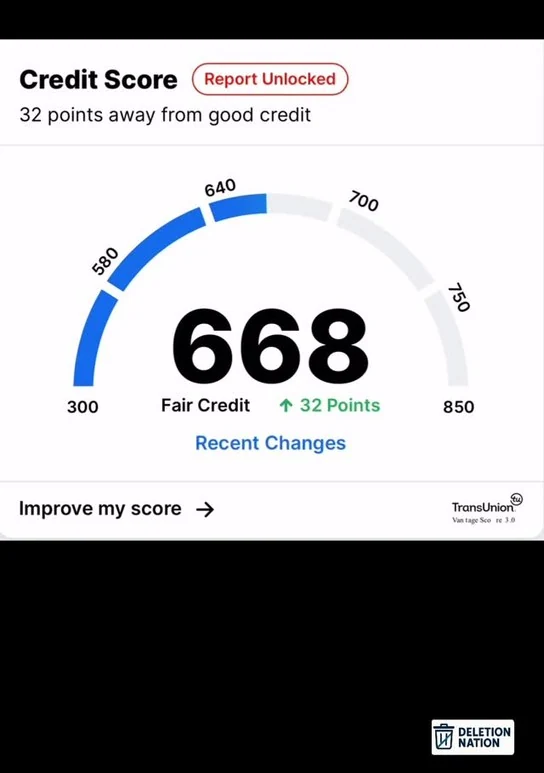
Three TransUnion clients cleared back to back in August 2025. One client had 8 inquiries deleted in a single sweep; another had Apple Card, Comenity, CareCredit, and USAA accounts removed; a third had a Synchrony account deleted. One client rose 32 points overnight, to 668.
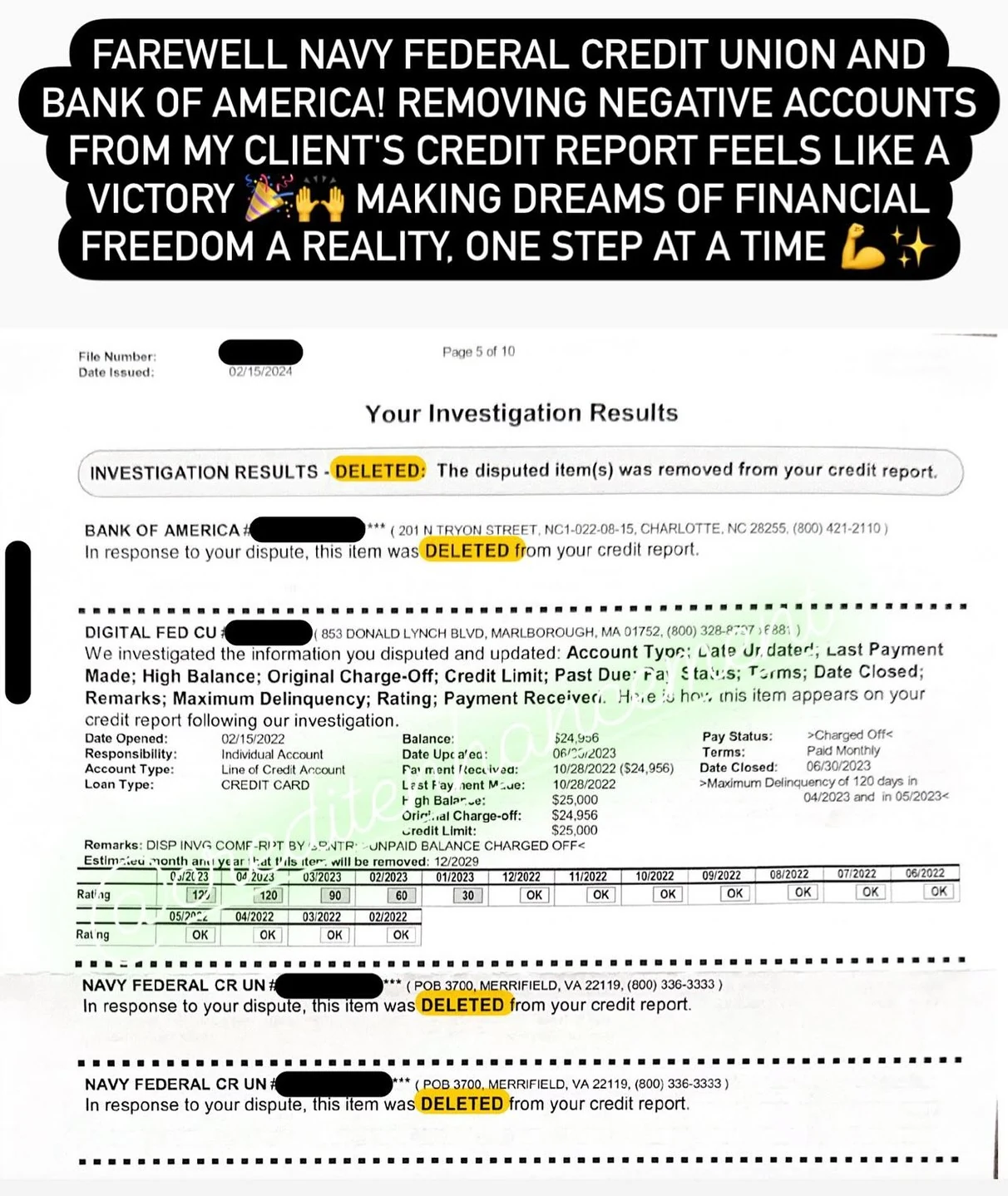
A February 2024 bureau investigation letter showing a Bank of America account and two Navy Federal accounts deleted from a client's credit report after dispute.
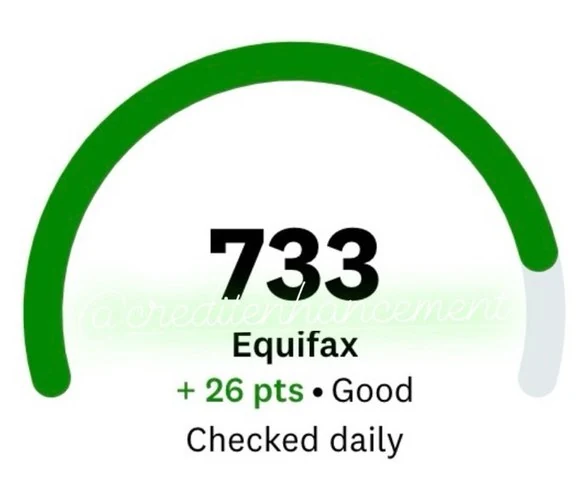
A client reached 733 on Equifax after a 26-point increase, March 2024.
Results vary from person to person and depend on what is in each credit file. Nothing here promises a particular score increase or deletion.
You can't write a good goodwill letter about an entry you haven't read. Check the late payment — the date, the days late, the account — on all three bureaus first.
For a dollar, you can read your scores and entries from Equifax, Experian, and TransUnion before you decide what to do about them.
A dollar with MyScoreIQ opens 7 days of access to your scores, then $34.99 a month if you keep it. Cancel anytime.
Goodwill Letters can look different from one report to the next. We help you understand the details and spot accuracy problems.
We help you decide whether your late payment is the kind a goodwill letter can help — a one-off late on an otherwise clean account.
We review the exact late payment entry so the letter names the right account and date.
We talk through how to explain what happened briefly and honestly.
We explain how to find the right department or address instead of a general inbox.
We talk through when to follow up and when to accept the answer.
A Goodwill Letters entry feels personal, but on a report it is just data — dates, amounts, and a status. We help you read it as data first.
The same account can look different on each bureau. We help you check all three before you act on any one of them.
We explain dispute options, what records to keep, and practical habits that help you stay current going forward.
We talk through the late payment entry and whether it is accurate.
We help you choose between a goodwill request and a dispute.
We help you write a short, specific goodwill letter in your own words.
We explain what to do when the creditor answers — or doesn't.
A goodwill letter asks a creditor to remove an accurate late payment from your credit reports as a courtesy. The creditor is under no obligation to agree.
For a one-off late payment on an account with an otherwise on-time history, where the account has been current ever since. It is a much weaker play for accounts with multiple late payments.
Not a general customer service inbox. Try the creditor's executive customer service, office of the president, or a credit reporting department — a phone call first can get you the right address.
One page. Name the account, the date of the late payment, what happened in a sentence or two, and the clean history since — then make the ask clearly.
Wait at least 30 days, then send it again with a short follow-up note. A second or third try is normal. If the creditor declines or never answers, the late payment falls off on its own in up to seven years.
No. If the entry is wrong, dispute it. A goodwill letter admits the entry is accurate, and you do not want to admit accuracy for an entry that is actually wrong.
That is exactly the profile a goodwill letter is made for. Let's look at your file and talk about whether it's worth sending one. Call (346) 301-6424.